Single-flue and multi-flue caps on brick, block and stone chimneys
Chimney Cap Installation and Replacement in Eau Claire, WI
Stainless or copper caps sized to your flues, fastened so the wind keeps them on, with mesh that suits what you burn. If the problem is really the masonry under the cap, we tell you that instead.
Serving Eau Claire, Altoona, Chippewa Falls, Lake Hallie, Menomonie, Fall Creek and the surrounding Chippewa Valley
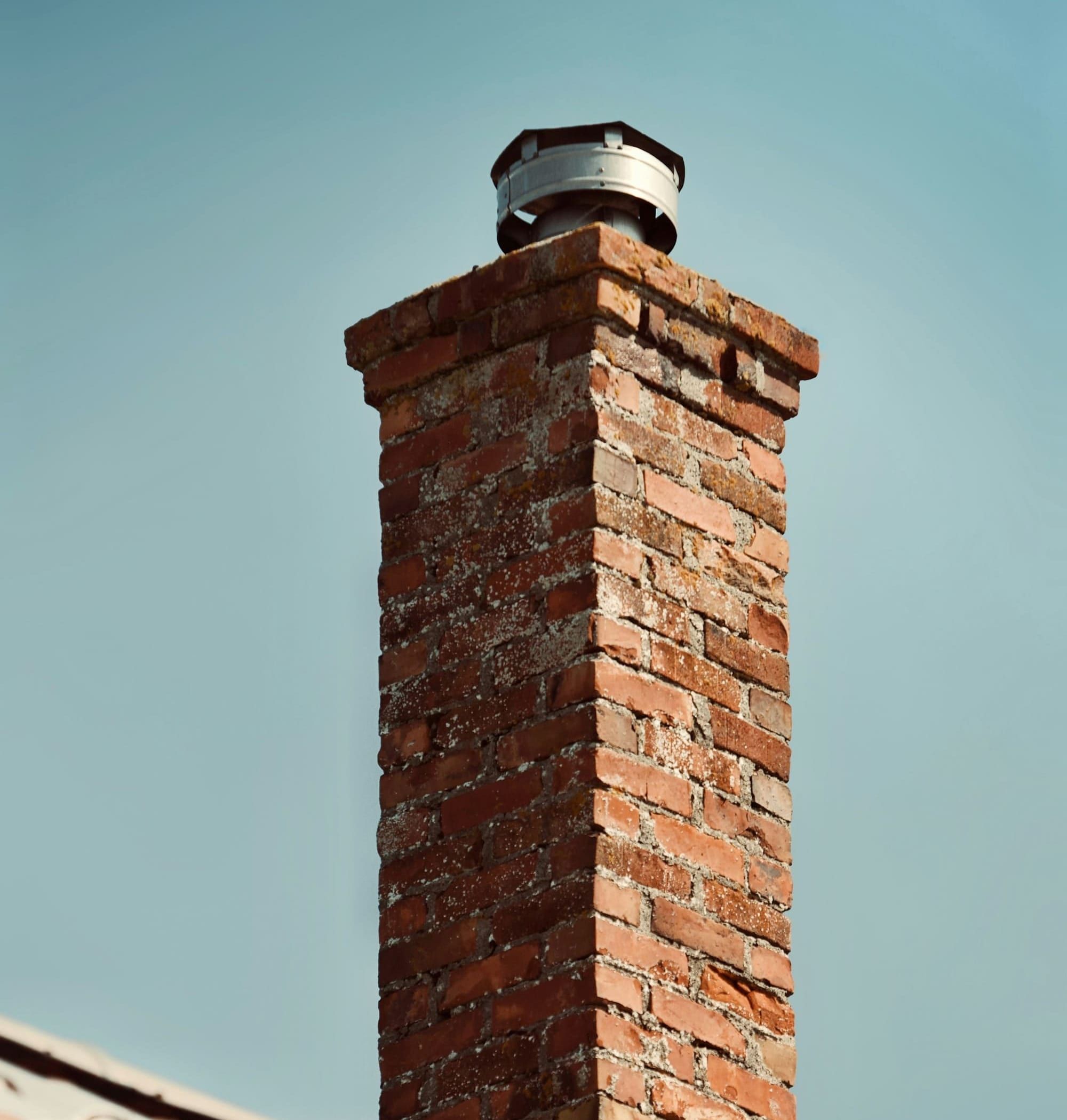
Do You Need a Chimney Cap? What an Open Flue Lets In
An open flue is a hole in the roof with a fireplace at the bottom. If a chimney is in use, or might be again, it should have a cap.
- Rain and snow. They fall straight down an open flue, rust the damper, soak the smoke shelf and wash mortar out of the firebox joints from behind. The Chimney Safety Institute of America puts it bluntly: water does more damage to masonry chimneys than fire.
- Animals. To a raccoon, a squirrel or a bird, an open flue is a hollow tree with a warm room at the bottom. Nests block the flue, and animals that fall in can’t climb back out.
- Sparks. On a wood-burning flue, the mesh on a cap stops the larger embers before they land on the roof or in the leaves in the gutter.
- Leaves and gusts. Leaves blow in and collect on the smoke shelf. Wind gusting across an open top can push smoke back down the flue; a hood helps with that, though it is not a cure for a chimney that drafts badly.
Single-Flue vs Multi-Flue Chimney Caps: How Each One Mounts
There are two ways to put a cap on a masonry chimney, and the chimney usually decides between them, not the homeowner. Older Eau Claire houses, the kind built along the Third Ward's streets between about 1870 and 1910, often have one stack carrying two or three flues: a fireplace, an old furnace or stove flue, sometimes a second fireplace upstairs.
When a single-flue cap is the right one
One flue, or several flues spread apart, each with a sound tile standing far enough above the crown to clamp to. A single-flue cap covers only its own flue, so on a two-flue chimney each one needs its own. They are the least expensive option and the easiest to replace later.
When it has to be a top-mount cap
Flues set close together, tiles cut off flush with the crown, or tiles too short or too damaged to grip. A top-mount cap covers the whole top and fastens to the crown, so the crown has to be solid enough to hold the anchors. Many are made to measure, which is most of why they cost more.
- The lid. Solid metal over the flue opening, high enough above it that smoke leaves freely. Cost guides put it at least 5 to 8 inches above the top of the flue.
- The mesh. The screen on the sides. It keeps animals out and doubles as a spark arrestor on a wood-burning flue. Its opening size matters more than most people think (see below).
- The clamp. A single-flue cap holds on with screws or a bolted band pinched against the outside of the flue tile. It needs a few inches of sound tile above the crown to grip.
- The flue tile. The clay liner. If its top is cracked or crumbling, the cap has nothing solid to hold, and that has to be fixed first.
- The crown. The concrete or mortar slab the flues stand in. It is masonry, not part of the cap, and the cap does nothing to protect it.
- The flange. A top-mount cap has a skirt or flange around the bottom that is fastened down into the crown with masonry anchors and bedded in sealant.
Stainless, Copper or Galvanized: Choosing a Chimney Cap Metal
The price gap between the metals is smaller than the gap in how long they last. On a chimney you plan to keep, the cheapest cap is rarely the least expensive one over ten years.
| Galvanized steel | Stainless steel | Copper | |
|---|---|---|---|
| Installed price, standard size | $325–$375 | $475–$600 | $575–$650 |
| Installed price, custom size | $425–$485 | $650–$780 | $750–$845 |
| How long it lasts | Up to about 5 years | Up to about 10 years | Can last the life of the house |
| What happens as it ages | The zinc coating weathers off, then it rusts, and the rust runs down the brick in orange streaks | Stays bright; the mesh is what eventually wears, mostly on wood-burning flues | Turns brown and then green, which runs onto light-colored brick and stone |
| Where it makes sense | A short-term fix on a chimney that is coming down or being rebuilt soon | Almost every masonry chimney in use, and what we suggest unless there is a reason not to | Older houses where the look matters and the budget allows |
Installed prices and lifespans are national figures from Fixr's chimney cap replacement cost guide (updated August 29, 2025); HomeGuide's guide (February 2026) lists nearly the same prices. Checked October 2026. Typical ranges, not quotes.
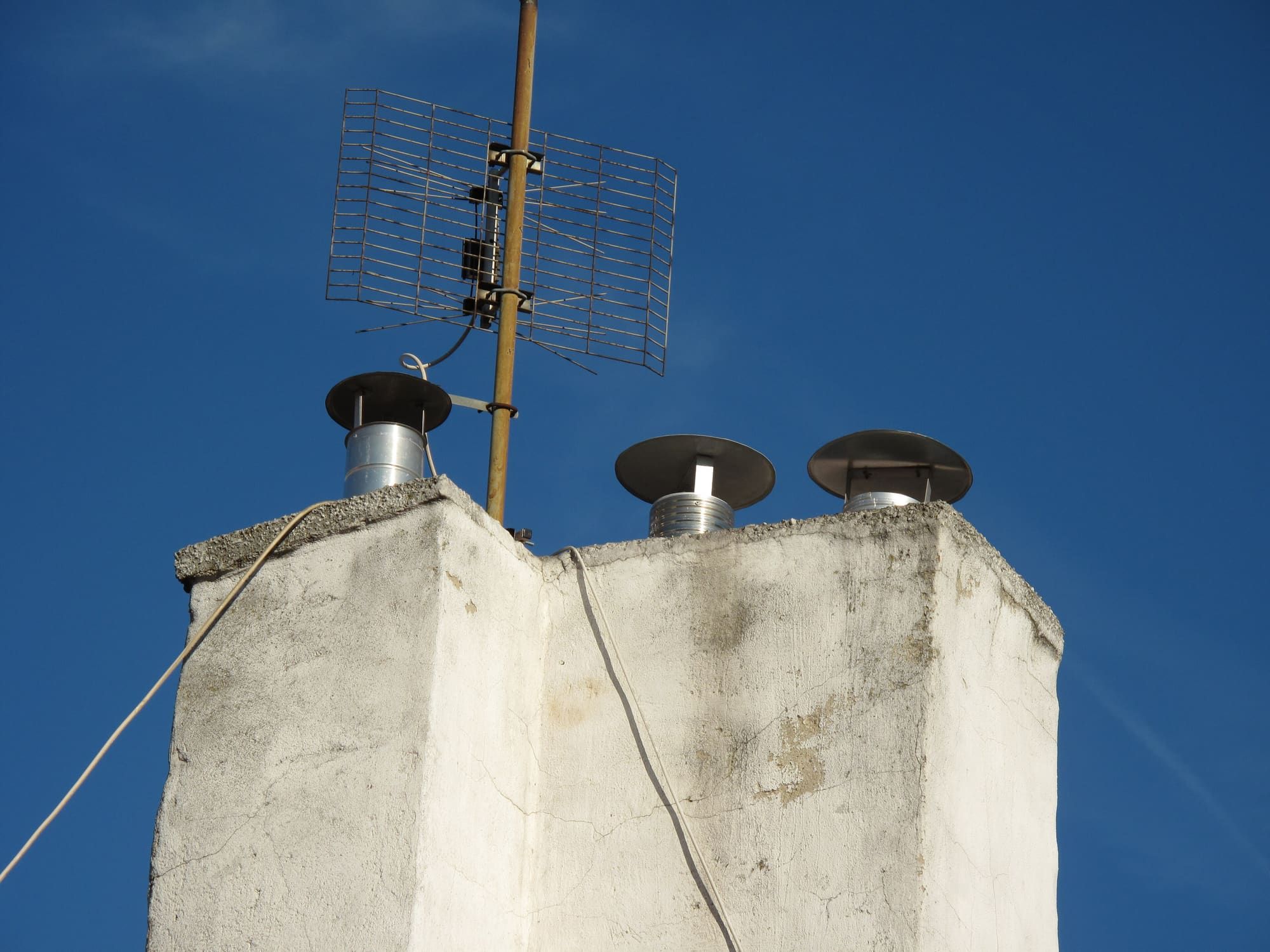
Rain caps without mesh, and why we rarely fit them
A rain cap is just the lid on legs. It keeps water out and does nothing about animals or sparks, and in our part of Wisconsin the animals are half the reason for having a cap. We fit caps with mesh on every side unless there is a reason not to.
No cap keeps out every drop. Rain and snow driven sideways by wind get through the mesh, and that small amount is harmless. What the cap stops is the steady soaking an open flue takes every time it rains.
Chimney Cap Blown Off or Hanging Sideways? Text a Photo From the Yard
Zoom in on the top of the chimney from the ground and send what you see, plus a shot of the cap if it's lying in the yard. We can usually tell from that whether it needs refastening, a new cap of the same size, or work on the flue tile before anything goes back on. Until then, keep the fireplace damper shut.
Spark Arrestor Mesh on a Wood-Burning Chimney: Why Caps Clog
The mesh on a cap is a spark arrestor, and it is also the part that fails a wood burner. Smoke from wood leaves creosote and soot on everything it touches, and a fine screen collects it until the openings close up. Fixr's guide warns what follows: airflow drops and fumes can come back into the house.
Wisconsin writes its own code for houses, the Uniform Dwelling Code, and it says nothing about spark arrestors at all. The national model code, the IRC, does not require one either, but sets rules for one when it is installed: openings no larger than 1/2 inch and no smaller than 3/8 inch, and a screen that can be removed for cleaning. Those two limits are a fair summary of the trade-off. Smaller holes stop more sparks and clog faster.
What we fit on a wood-burning flue
- Stainless mesh in that 3/8 to 1/2 inch range, never fine screen, on any flue that burns wood.
- A cap with a lid that lifts off or hinges, so a sweep can clean the screen and the flue without cutting anything.
- On a stove that burns hard every day all winter, a talk with your sweep about how often the screen needs brushing.
Supply companies sell "wood style" caps with more open screening for exactly this reason, trading some pest protection for less buildup. If your cap is packed with black crust every spring, that is the fix, along with a look at how the fire is being burned.
Spark arrestor rules in the IRC, R1003.9.2
- 3/8–1/2 in
- mesh openings: no larger than 1/2 inch, no smaller than 3/8 inch
- 4×
- the screen's open area is at least four times the area of the flue outlet
- 24 ga
- stainless at least as heat- and rust-resistant as 24-gauge, or 19-gauge galvanized
- Removable
- the screen or cap comes off so the flue can be cleaned
International Residential Code R1003.9.2, as reproduced in published code references (ICC text not directly accessed). Wisconsin's UDC, SPS 321, has no spark arrestor provision. Read October 2026.
Why Chimney Caps Blow Off in Eau Claire Wind
The state climatology office's wind records for Eau Claire (1949–1993) average about 10 miles an hour over the year, mostly from the west-southwest, with April the windiest month at about 12. A chimney is the highest, most exposed thing on the house, and a cap catches that wind like a small sail. Caps that end up in the yard almost always went for one of four reasons.
- Wrong size. A cap bought a size up so it would “fit anything” is held by screws reaching across a gap. They loosen within a season.
- Short or broken tile. The screws are biting the last inch of a flue tile, or a tile whose top has cracked and crumbled around them.
- Screws never retightened. Heat from the flue and our winter freeze-thaw swings work them loose a little at a time.
- Rust. On a galvanized cap the band, the screws or the legs rust through and the lid simply lifts off.
How a replacement chimney cap gets installed and fastened
-
Check the flue tiles before ordering
We check the flue tile tops, the crown, what burns in each flue, and whether anything is living in the chimney. A cap goes on a chimney that is ready for it, not over a problem.
-
Measure every flue
Outside size of each tile, how far each one stands above the crown, and for a top-mount cap the whole top and the tallest flue. Odd sizes get a cap made to fit.
-
Old cap off, top cleared
The old cap comes off and leaves, nests and loose mortar come off the crown. Anything we can see down the flue that needs a sweep goes in our notes for you.
-
Fasten the cap for wind
Single-flue caps are tightened to the tile on every side. Top-mount caps are anchored into the crown at each corner and sealed. Then we tug on it, hard.
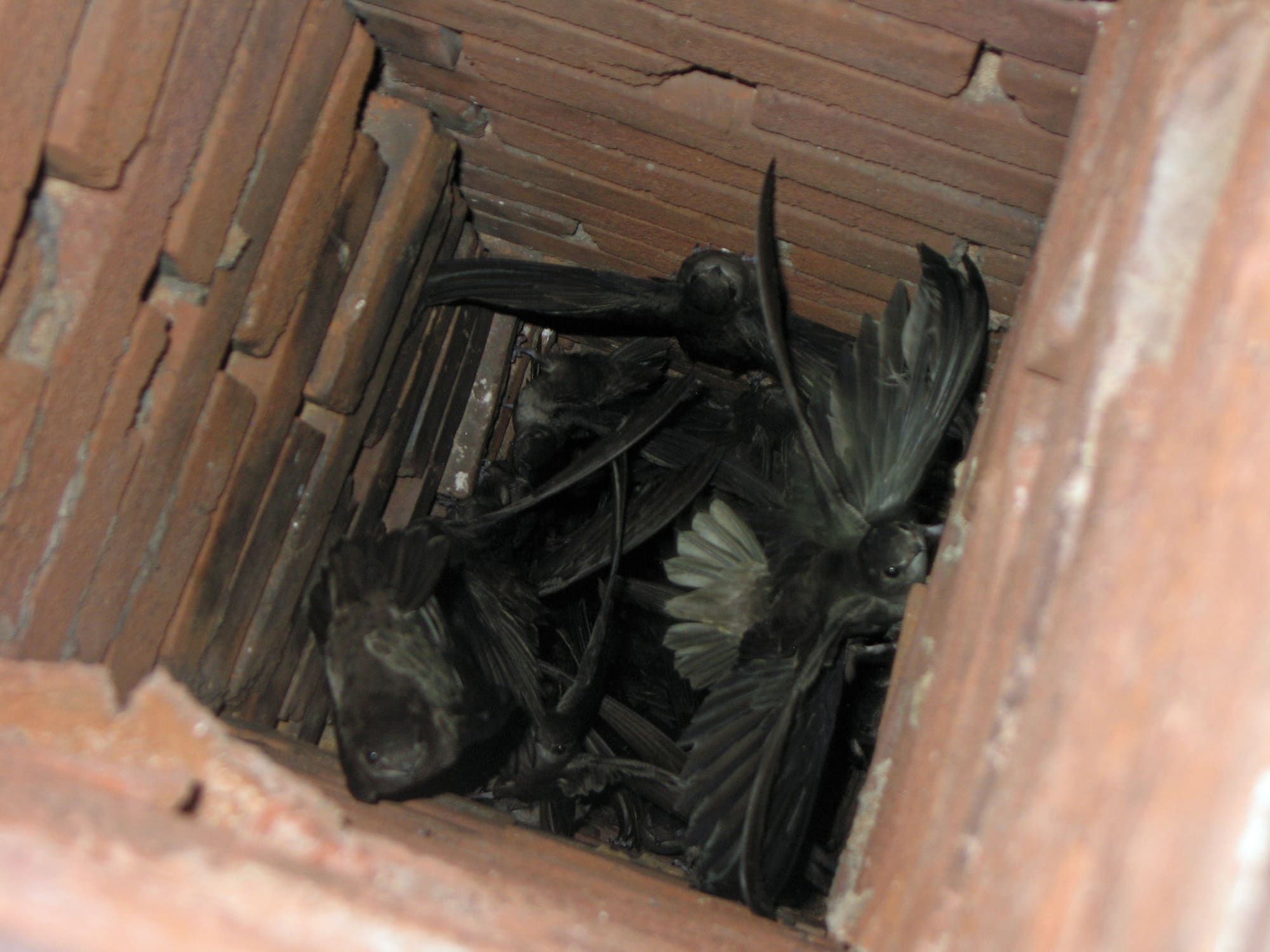
Chimney Swifts and Raccoons in Eau Claire Chimneys: When to Cap
The most common reason people call about a cap in spring and summer is a noise in the chimney. What it is decides when the cap can go on.
Chimney swifts: wait until they leave
Chimney swifts are small, dark birds that cling to the inside of open masonry chimneys to nest and roost, and a steady chattering inside the chimney in summer is often a swift nest. They are protected under the federal Migratory Bird Treaty Act, so an active nest can't be disturbed or sealed in. The Wisconsin DNR says they start migrating south as far as the Amazon from mid-August in the north of the state, and that their numbers have fallen by 72 percent in 50 years, partly because chimneys get capped and torn down.
So the cap goes on in the fall, after the swifts have gone and before they come back in spring. The chair of the Wisconsin Chimney Swift Working Group gives the same advice for any chimney work. And Humane World for Animals advises that a chimney with a metal liner should always be capped.
Raccoons and squirrels in the flue
A mother raccoon will use a chimney as a den. The Wisconsin DNR says kits are usually born in April or May, and that at about six to eight weeks the mother starts moving them to another den herself, one at a time, over several nights. Its advice: cap the chimney after the whole family has left. Capping it with kits inside traps them. If you aren't sure the chimney is empty, a wildlife removal service can check before we go up.
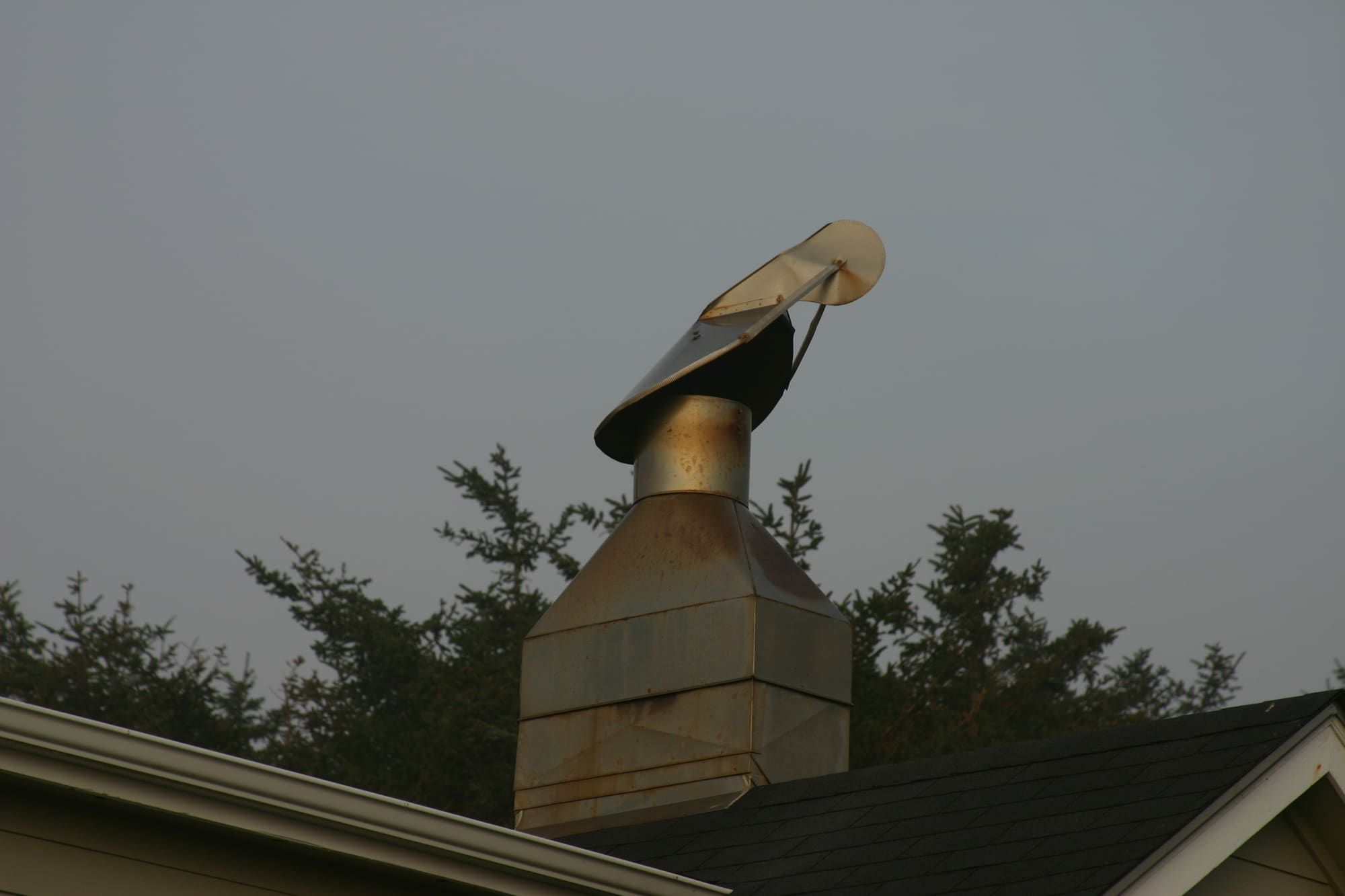
Chase Covers: The Sheet-Metal Lid on a Framed Chase, and Who Replaces It
Many houses built in the last few decades don't have a masonry chimney at all. They have a chase: a wood-framed box on the outside wall, finished in siding, stucco or stone, with a factory-built fireplace inside and a metal flue pipe up the middle. A chase cover is the sheet-metal lid on top of that box, with a hole and a collar where the flue pipe comes through and the pipe's own cap above it.
We don't make, install or repair chase covers. They are sheet-metal work. Call a roofer or a sheet-metal fabricator for the cover. The metal flue and its cap are work for a sweep or the dealer who sells that brand of fireplace, because Wisconsin's code requires a factory-built fireplace to be kept up according to its listing. If the chase is faced in stone and the stone is loose, that part is masonry and we can fix it.
Masonry chimney or framed chase? How to tell
- What is on the sides. Siding, stucco or stone panels around a box shape usually mean a framed chase. Brick or block you can see mortar joints in usually means masonry. Stone can be either.
- What is on top. A masonry chimney ends in clay flue tiles standing in a concrete or mortar crown. A chase ends in a sheet of metal with a round metal pipe and collar through it.
- What is inside. A factory-built fireplace has a metal firebox, often with thin refractory panels and a metal flue pipe. A masonry fireplace is firebrick laid in mortar.
Why chase covers leak, and what a good one looks like
Most original chase covers are thin galvanized steel, flat or nearly flat. Water sits on them, the zinc wears through, and they rust, sag and let water in around the collar and down inside the chase. Rust streaks running down the siding below are a common sign.
A good replacement, according to suppliers such as Rockford Chimney Supply, is stainless or copper, at least 24 gauge, with diagonal creases called cross breaks so water runs off instead of pooling, and a drip edge that holds it clear of the siding. HomeGuide puts a chase cover at $300 to $700 installed. Ask for those details in writing, whoever you hire.
Chimney Cap Replacement Cost in Eau Claire
No cost guide publishes Chippewa Valley prices for chimney caps, so these are national figures. They are typical ranges, not quotes, and they assume a roof that can be walked or reached with a ladder.
| Job | Typical range | What the guides say |
|---|---|---|
| Single-flue cap, standard size, installed | $250–$425 | Fixr: $250–$285 for an 8 × 8 inch flue, $350–$425 for 13 × 13. HomeAdvisor’s national average for a cap is about $300. |
| Multi-flue or large custom cap, installed | $590–$910 | Fixr: $590–$650 for a 17 × 29 inch top, $625–$700 for 14 × 37, and up to $910 for custom stainless or copper. |
| Cap on a chimney that never had one | $220–$685 | Fixr. Slightly less than a replacement because there is no old cap to cut off and haul away. |
| Chimney cap repair | $100–$250 | Fixr’s chimney repair guide: refastening, straightening or replacing a damaged part of a cap that is otherwise sound. |
| Labor alone | $150–$350 | HomeGuide $150–$350, Fixr $200–$350. The roof, not the cap, decides most of it. |
Sources: Fixr, chimney cap replacement cost guide (updated August 29, 2025) and chimney repair cost guide (updated January 31, 2025); HomeGuide, chimney cap cost guide (updated February 9, 2026); HomeAdvisor, chimney cap installation cost guide (updated June 20, 2026). National figures, checked October 2026.
What moves a chimney cap price
Getting up there. The cap itself is often the smaller half of the bill, and a steep pitch, a second story or a chimney far up the roof adds time whatever cap goes on it. After that: the metal, how many flues and how big, and whether a stock size fits or the cap has to be made to measure.
Chimney cap repair or a new cap?
Refastening a sound stainless cap is a repair. A rusted-out galvanized cap, a torn screen or a cap that never fit is a replacement. If the flue tile or crown has to be fixed before a cap can hold, that work is priced separately on the same estimate so you can see what each part costs.
Chimney Cap Questions: Who Fits Them, How Long They Last, Gas Furnaces
Who installs chimney caps: a mason, a roofer or a chimney sweep?
All three do. A sweep is the right call when the flue also needs cleaning or an inspection, because they can look down it before the cap goes on. A roofer often fits one during a re-roof. A mason is the right call when the top of the chimney needs work first: a crumbling flue tile, a cracked crown or loose brick at the top. A new cap on a bad top comes loose. We install caps on masonry chimneys, and we tell you if the sweep should see it first.
Can a chimney cap be repaired, or does it need replacing?
A cap that is bent, loose or has screws backed out can usually be straightened and refastened, and Fixr's national guide puts that kind of cap repair at $100 to $250. A galvanized cap that has rusted through, or a mesh that has torn or rusted away, is not worth patching. Replacing it with stainless costs little more than a repair visit and ends the problem.
How long does a chimney cap last?
It depends almost entirely on the metal. Fixr's cost guide gives galvanized caps up to about five years and stainless steel up to about ten, and says copper can last the life of the house. On a wood-burning flue the mesh usually wears before the lid does. HomeAdvisor suggests expecting to replace an ordinary cap every five to ten years.
Does a gas furnace or water heater flue need a cap?
A flue that vents a gas appliance is part of that appliance’s venting system, and what goes on top of it is the heating contractor’s or sweep’s call, not ours. We don’t do gas venting. If your chimney has a fireplace flue and a furnace flue side by side, tell us. We cap the masonry flue, and a top-mount cap covering both goes on only after the heating contractor confirms it suits the appliance vent.
Will a chimney cap stop my fireplace from smoking?
Only if the smoke is being pushed back down by wind across the top. Most smoky fireplaces have other causes: a chimney too short for the roof around it, a firebox opening too big for the flue, a tight house pulling air down the chimney, or a dirty or blocked flue. Have a sweep look at the draft before buying a special cap. If they find wind is the cause, a hooded cap is a sensible next step.
Can a chimney cap be installed in winter?
Usually, yes. Fitting a cap involves no mortar or concrete, so cold alone does not stop it. Snow and ice on the roof do, because the roof has to be safe to work on. A cap that blew off in a storm can often go back on within days, weather allowing, and in the meantime an open flue is worth keeping the fireplace damper closed for.
Can I install a chimney cap myself?
If the roof is low and walkable, the flue tile is sound and stands a few inches above the crown, and a standard single-flue cap fits it, yes. Measure the outside of the tile, buy stainless, and tighten every screw evenly. Leave it to someone else if the roof is steep or two stories up, the tile top is cracked, the flues are odd sizes, or the cap would have to fasten into a crown that crumbles when you drill it.
Get a Free Chimney Cap Estimate
Send a photo of the top of the chimney from the yard, tell us how many flues it has if you know, and whether you've heard anything living in it. That is usually enough to price a cap before we come out.
- Tell us what burns in each flue: wood, gas or nothing
- Every flue measured, so the cap fits the first time
- Problems with the tile or crown priced separately, never slipped in
Get a Free Estimate
Tell us what's going on with the masonry or stucco. Prefer to talk? Call or text (715) 597-4359.
Thanks, we have your request.
We'll be in touch about your estimate. If it's easier, text photos of the job to (715) 597-4359.
Get the Right Cap on the Chimney Before the Next Storm
Call, or text a photo of the chimney top. Questions about anything else on the house can go through the contact page, and the rest of what we do is on the Eau Claire masonry contractor home page.